TL;DR
- Start with your goal: a home for personal use, a rental property and an investment asset all call for different locations and selection criteria.
- Leave room in the budget: on top of the purchase price, buyers need to account for IVA, AJD, notary and registration fees, legal costs and, where applicable, mortgage-related expenses.
- Check the developer carefully: look at completed projects, permits and guarantees covering advance payments.
- Apply for your NIE and prepare your banking documents early: it is best to do this while you are still viewing and comparing properties.
- Do not treat the reservation agreement as a formality: the terms for refunding the deposit and making further payments should be clear before you sign.
- Legal due diligence is essential: the land, permits, encumbrances, guarantees and purchase contract should all be checked before substantial payments are made.
- If you need a mortgage, start early: bank approval takes time and usually requires proof of income and the source of funds.
- Inspect the property before taking possession: any defects should be documented before the final handover.
Spanish property has remained firmly in demand for years. Buyers, however, have become noticeably more cautious. They scrutinise developers’ paperwork, read contracts down to the last clause and ask lawyers questions that many people would barely have considered three years ago. That is a good thing. Spain’s new-build market is active, overheated in some places and still attractive in others, but it is certainly not a market where you should buy an apartment on instinct after seeing a polished rendering on a developer’s Instagram page.
If you are seriously considering buying a new-build property in Spain, this guide is for you. We will skip the usual talk about sunshine and wine – although, admittedly, Spain does both rather well – and focus on the process itself: what needs to be done, in what order and why, so that the end result is a set of keys rather than a headache and a lost deposit.
Step 1. Decide what you are buying the property for
It sounds obvious, but this is where many mistakes begin. Buying a home to live in, buying one to rent out and buying purely as an asset expected to appreciate are three very different strategies. They call for different locations, different types of property and different ways of assessing returns.
For a permanent home, day-to-day infrastructure matters: schools, healthcare and shops within easy reach. For rentals, especially tourist lets, proximity to the beach and the availability of a short-term rental licence in the municipality can be crucial. Such licences are far from universally available and, by 2026, restrictions have become tighter, with some cities freezing the issue of new licences altogether. If your priority is capital preservation and growth, it may make more sense to look at developing districts where construction is only beginning to accelerate and prices have not yet caught up with neighbouring established areas.
Until you can answer that question clearly, there is little point moving on.
Step 2. Set your budget – with a safety margin
The advertised price of the property is not the same as the total amount you will need. On top of the new-build purchase price, you should allow for:
- VAT (IVA) – 10% of the price for residential property, although different rules may apply in specific cases;
- stamp duty (AJD) – usually 0.5% to 1.5%, depending on the region;
- notary and Land Registry fees – generally around 1–1.5%;
- legal fees – around 1–1.5% of the property price, and this is not an area where cutting corners makes much sense;
- if you are financing the purchase – valuation fees, possible banking costs and insurance.
As a general rule, it is sensible to set aside around 12–15% on top of the purchase price for taxes and additional property purchase costs. Many buyers budget only for tax and are then surprised by the extra thousands of euros that appear towards completion. It is much easier to plan for them in advance.
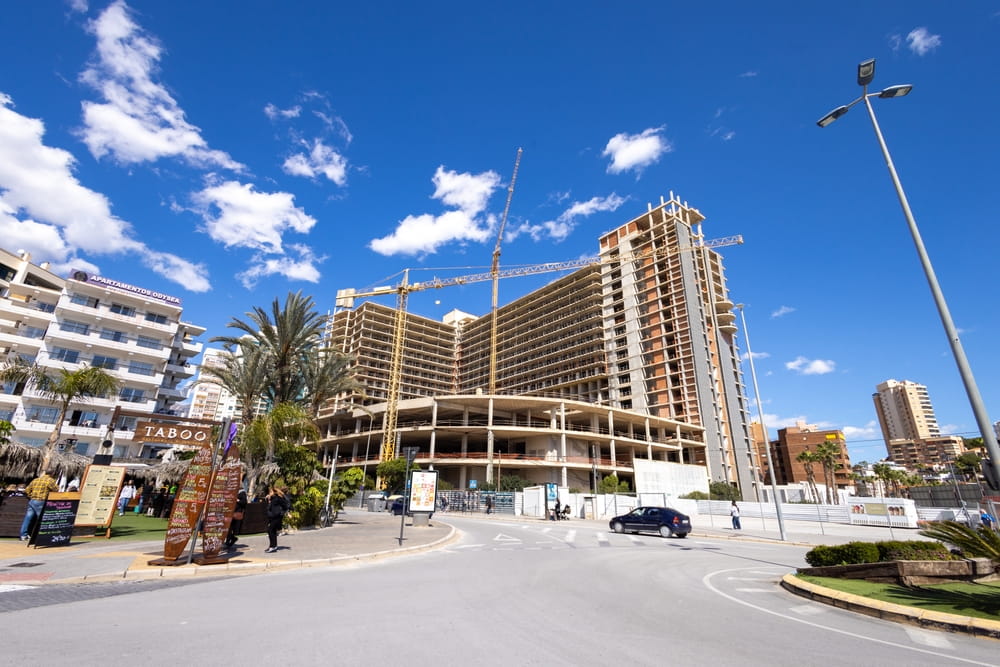
Step 3. Choose the region and check the developer
Spain is far from a single property market. The Costa Blanca tends to offer more accessible prices and a large international community, the Costa del Sol comes with a higher entry price and strong rental demand, Valencia continues to attract remote workers and digital nomads, while Madrid and Barcelona are a separate proposition for buyers looking for big-city liquidity. Each region has its own pace, its own construction pipeline and its own pressure points – in some places land is scarce, while elsewhere local authorities are slow to issue permits.
The developer deserves a separate and thorough check:
- How many projects has the company already completed, and how closely did it keep to the original schedule? You can check records through the Land Registry (Registro de la Propiedad) and speak to buyers who have already moved into earlier developments.
- Does the project have a bank or insurance guarantee covering buyers’ advance payments made before construction is completed? Spanish law requires such protection, and the developer must use a dedicated account backed by a bank or insurance company. Without that documentation, do not transfer funds, regardless of discounts or “special conditions for quick decisions”.
- What is actually happening on the developer’s current construction sites? Sometimes one visit is enough to tell whether the advertised completion dates are realistic.
Step 4. Find suitable properties and create a shortlist
This is usually the stage where a good estate agency becomes useful. Not because properties are impossible to find without one – portals such as Idealista and Fotocasa are open to everyone – but because an experienced agent can spot things that are not visible in the listing: the developer’s real track record, awkward aspects of the layout, or another construction project that may block the view in a year’s time.
At this stage, it makes sense to narrow your options down to five to seven properties and see at least some of them in person – ideally all of them. If you cannot travel to Spain beforehand, ask for a live video viewing rather than a pre-recorded promotional video with background music. The difference is obvious.
Want to compare new-build properties in different parts of Spain?
Alegria’s property catalogue lets you compare homes by location, price, property type and other key criteria.
Step 5. Obtain an NIE
The NIE (Número de Identificación de Extranjero) is a foreigner’s identification number. You will need it to buy property in Spain, deal with taxes and carry out a number of banking and administrative procedures. It can be obtained either in Spain through a police station or immigration office (Comisaría de Policía or Oficina de Extranjeros) or through a Spanish consulate in your country of residence.
The process can take time and appointment slots may be booked well in advance, so it is better to start dealing with the NIE at the beginning of your property search rather than waiting until the contract is ready and the seller is pushing for a signature. Many legal firms can also handle the application under a power of attorney, which can make the process much easier if you are not able to attend in person.
Still need an NIE?
Alegria can help prepare the documents and assist you throughout the application process.
Step 6. Open a bank account in Spain
Spanish law does not formally require you to hold a local bank account in order to buy property, but in practice it makes the entire process much easier. Payments ranging from the reservation deposit to utility bills after completion are commonly handled through a Spanish bank. Recurring charges such as IBI and non-resident tax are also easier to manage by direct debit than by making international transfers every time.
A non-resident opening an account will typically be asked for a passport, NIE – or proof that the application is in progress – evidence of the source of funds and, in some cases, proof of income. Some banks allow the process to begin remotely, but full access to services may still require a visit to a branch.
Step 7. Reserve the property and sign the reservation agreement
Once you have chosen the property, you will normally pay a reservation deposit of around €3,000 to €10,000, depending on the developer and the stage of construction. This takes the property off the market and fixes the price for an agreed period, usually around 15–30 days, giving you time to carry out legal checks and prepare the main contract.
It is worth being very clear about one thing: a reservation agreement is not a formality. It should spell out exactly when the deposit is refundable if the transaction falls through for reasons outside your control. Signing it without a translation you understand and without legal advice is not a good idea, however reassuring the sales representative may be.
Step 8. Carry out legal due diligence
This is the stage buyers sometimes rush through and later regret. A lawyer should check:
- the legal status of the land and the existence of all required building permits (licencia de obra);
- whether there are any charges, liens or debts attached to the property or development;
- whether the project complies with the municipality’s planning regulations;
- whether advance payments are properly protected by the bank or insurance guarantee mentioned earlier;
- the terms of the purchase contract, including penalties for delays on the developer’s side – these provisions can and should be addressed in the contract.
The legal review usually takes one to two weeks. Saving time by cutting back on due diligence is, quite simply, one of the easiest ways to create problems later in a new-build purchase.
Step 9. Sign the purchase contract (contrato de compraventa)
Once the legal checks have been completed, the main purchase contract is signed. It sets out the full purchase price, the payment schedule – normally several instalments linked to construction milestones such as the foundations, structure, roof and final fit-out – the completion date, penalties for delay on either side and the procedure for handing over the keys.
One point deserves particular attention: every scheduled payment should go to the protected account covered by the relevant guarantee. Check the bank details on each payment instruction and make sure they match the details stated in the guarantee documentation.
Step 10. Arrange the mortgage, if you need one
Foreign buyers can apply for a mortgage from a Spanish bank. Financing is often around 60–70% of the property value, although stronger borrower profiles may receive somewhat better terms. Fixed mortgage rates in 2026 are around 3–4% in the scenarios discussed here, but the actual offer depends on the individual borrower and the bank’s assessment.
The bank will usually ask for proof of income covering the previous two or three years, tax returns, bank statements and sometimes evidence of other outstanding credit commitments. Approval can take three to six weeks, so if a mortgage is part of your plan, it makes sense to start the process alongside the legal due diligence rather than after signing the main contract.
Planning to finance a new-build purchase with a mortgage?
Alegria can help prepare the paperwork and coordinate the application with Spanish banks.
Step 11. Keep track of construction
While the property is being built – typically 12 to 24 months for a new development, depending on the size and complexity of the project – it is worth keeping a close eye on progress. Good developers usually send photo updates and invite buyers to intermediate site visits. If they do not, ask. That is normal buyer behaviour, not an inconvenience.
If the timeline begins to slip, go back to the contract and check what it says about delays and the remedies available to you. A delay of a month or two is not unusual in the Spanish market, but if work has been stalled for six months, it is time for a serious conversation with your lawyer.
Step 12. Carry out the final inspection
Before the final handover, the property should be inspected. This is the stage commonly associated with llaves en mano – literally “keys in hand”. Check everything: plumbing, electrics, windows, finishes and whether the property matches the specifications and measurements stated in the contract. Any defects should be recorded in a snagging report so that the developer can address them before the handover is fully completed.
Bring a notebook and your phone, and take photos or video as you go. Minor issues such as a door that does not close properly or a chipped tile are common in new builds. They are not necessarily cause for alarm, but they should be documented.
Step 13. Sign before a notary and register ownership
The final stage of the transaction is signing the public deed (escritura pública) before a notary. At this point, the outstanding balance is paid, the parties sign the deed and you formally become the owner. The deed is then submitted to the Land Registry (Registro de la Propiedad), where registration can take anything from several weeks to a couple of months.
This is also when the VAT and stamp duty discussed in Step 2 need to be settled, so the funds for these costs should already be available rather than still being transferred from elsewhere.
Step 14. Transfer utilities and deal with ongoing taxes
Once you receive the keys, electricity, water and, where applicable, gas contracts need to be transferred into your name. Developers often help with this at the handover stage, but it is better to establish in advance who is responsible and how long the process will take. Alegria also offers a dedicated utility contract transfer service for new property owners.
After that comes the ongoing tax side of property ownership in Spain:
- IBI – the annual municipal property tax – is based on the cadastral value and the rules of the local municipality;
- if you are not tax resident in Spain and do not rent the property out, you may still have to pay imputed non-resident income tax (Impuesto sobre la Renta de No Residentes) calculated using the cadastral value;
- if the property is rented out, tax is calculated on actual rental income, with rules that vary depending on the owner’s tax status.
You can deal with these obligations yourself, but many owners prefer to appoint a Spanish tax adviser to handle the annual filings. It is usually a modest cost compared with the time and administrative work it can save.
What has changed in 2026
There are also a few points worth keeping in mind specifically in 2026.
First, several coastal municipalities have tightened the rules for short-term rentals. If you are buying with tourist letting in mind, check the rules in the specific municipality before signing the reservation agreement, not afterwards.
Second, demand from digital nomads and remote workers continues to support demand in cities such as Valencia and Alicante, which is also having an effect on new-build prices in these markets.
Third, banks are paying closer attention to the source of funds in larger transactions, so documents proving where the purchase money comes from should be prepared well in advance rather than left until the days before completion.
At Alegria, we go through this process with our clients from the first enquiry to the moment the keys are finally in their hands, and we still find ourselves rooting for every transaction as if it were our own. Spain offers plenty of sunshine and plenty of bureaucracy, and our job is to make sure you deal with as little of the second as possible. If any of the fourteen steps above have raised questions – and they usually do – get in touch. We will look at your particular situation and tell you where it makes sense to start.
FAQ
How much should I budget for additional costs when buying a new-build property in Spain?
A reasonable working estimate is around 12–15% on top of the property price. This can include IVA, AJD, notary and Land Registry fees, legal costs and mortgage-related expenses where applicable.
Do I need an NIE to buy a new-build property in Spain?
Yes. The NIE is the identification number used by foreign nationals for property purchases, tax matters and other administrative procedures in Spain. It is best to start the application early.
What should I check about a developer before buying?
Check the developer’s track record, current construction sites, the relevant permits and the guarantees protecting buyers’ advance payments before completion.
Can a foreign buyer get a mortgage for a new-build property in Spain?
Yes. Spanish banks commonly lend to foreign buyers, although financing levels and terms depend on income, credit profile, residency status and the bank’s assessment.
What should I inspect before accepting the keys to a new-build property?
Check the plumbing, electrics, windows, finishes and whether the property matches the agreed specifications. Any defects should be recorded in writing before the final handover.
This information does not constitute legal or tax advice and is not a public offer.